Star Rubies: How a Six-Rayed Star Appears Inside a Gem
By the gemologist team at The Natural Ruby Company. Last reviewed: 12 November 2026.
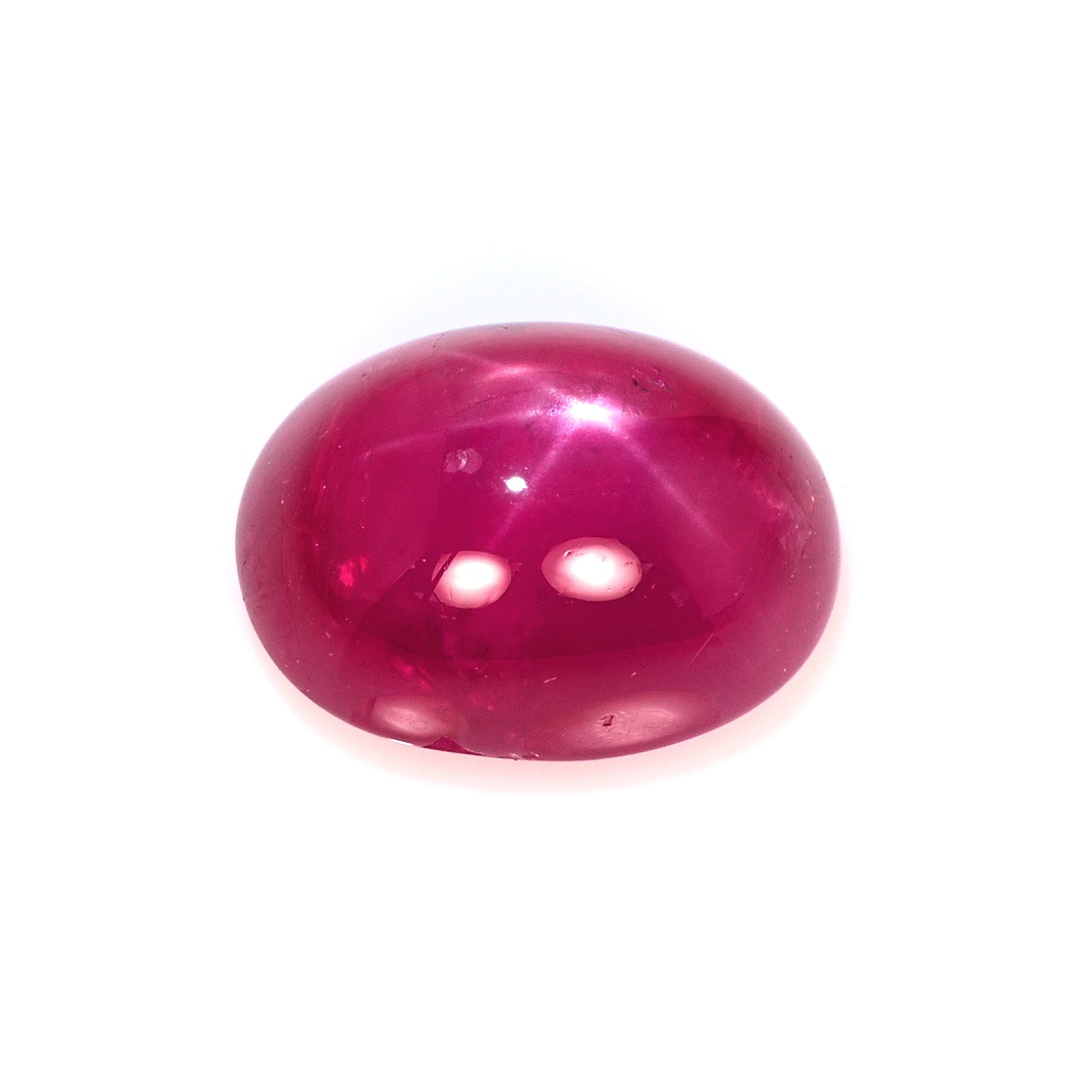
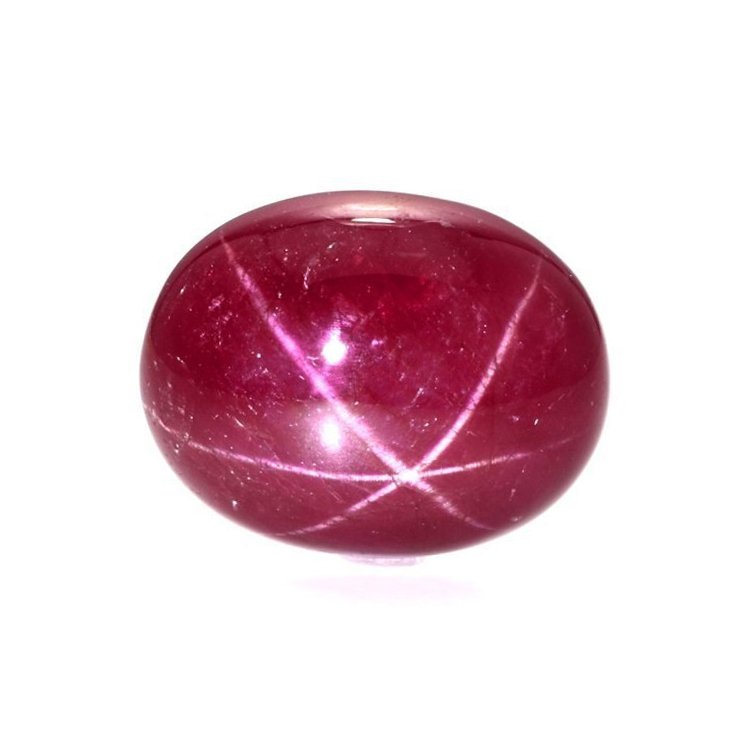
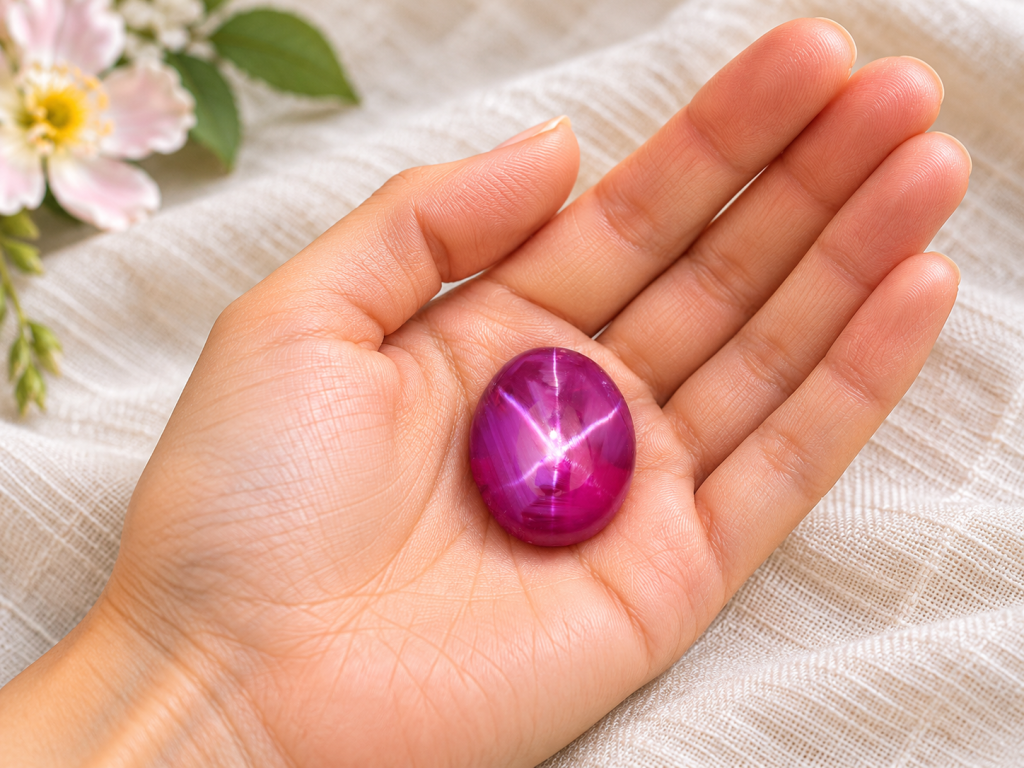
What is a star ruby? A star ruby is a ruby, normally cut as a smooth cabochon, that shows a six-rayed star floating on its surface. The star is called asterism. In a natural star ruby it is caused by countless microscopic needles of rutile (titanium dioxide) that grew inside the crystal in three directions, and it glides across the stone as the light moves. Synthetic and diffusion-treated star rubies are common, so the real buying question is not only “is there a star?” but “where did the star come from?”. Below we explain how the star forms, how to tell natural from synthetic, and how to judge a star ruby.
How Does the Star in a Star Ruby Form?
Rubies grow slowly underground. As a crystal cools, titanium that was dissolved in the corundum can separate out as thin needles of rutile. In a star ruby these needles line up along three directions in the crystal, crossing at 60 degrees. They are called “silk” because of their fine, fiber-like look.
A cutter then does something unusual: instead of faceting the rough, the cutter shapes a dome, a cabochon, with the base of the dome parallel to the plane where the needles lie. Light hits the needles, reflects off them in bands perpendicular to each set of needles, and the bands cross at the top of the dome. Three crossing bands make six rays. Move the stone, or the light source, and the star moves too.
Star sapphires form in exactly the same way, since sapphire and ruby are both corundum. For the most famous example, see our sister site’s story of the Star of India, the 563-carat star sapphire at the American Museum of Natural History.
Why Does the Star Look Best Under One Light?
A single light source such as a window, a lamp or a phone torch gives the cleanest, sharpest star. Under multiple lights, you may see several stars at once, and in diffuse daylight a star can fade almost completely. If you want to understand why this is true of other inclusions, see our post on what inclusions tell us about a natural ruby.
What Is the Most Famous Star Ruby?
The best-known star ruby in the world is probably the Rosser Reeves Star Ruby, a 138.7-carat Sri Lankan gem in the collection of the Smithsonian’s National Museum of Natural History in Washington, DC. It is celebrated for the quality of its six-rayed star and its saturated red. Seeing it makes one point clear: star rubies are valued for the star’s sharpness, its centering and the stone’s color, all at once.


Are Star Rubies Natural or Synthetic?
Both exist, and synthetic star rubies have been sold widely in jewelry for decades. Knowing the difference is the most important part of buying a star ruby.
Synthetic star rubies. In the late 1940s Linde Air Products Company in the United States patented a way to grow star corundum in the laboratory, and “Linde stars” became widely sold in jewelry from the 1950s onward. Other makers followed. According to GIA’s Gems & Gemology, these flame-fusion synthetics show curved growth layers and gas bubbles inside, features never found in natural ruby. To the eye, a synthetic often has a star that is too perfect: very sharp, thin, evenly bright rays on a very even, often semi-transparent body color.
Diffusion-treated stars. Asterism can also be created or strengthened by heating a stone with titanium so that rutile needles form only in a thin layer just under the surface. GIA’s research on double stars notes that diffusion has been used this way since the 1950s, on synthetic and possibly natural corundum. Because the star lies only in the surface layer, it can be weakened or lost if the stone is ever re-polished.
Natural star rubies. A natural star usually has slightly uneven rays, natural color zoning and the silk and small inclusions typical of mined ruby. That irregularity is part of its character.
| Natural star ruby | Synthetic (Linde-type) star ruby | Diffusion-induced star | |
|---|---|---|---|
| Origin of the star | Rutile silk that grew in the crystal | Rutile formed during laboratory growth and annealing | Rutile formed in a thin surface layer by treatment |
| Look of the star | Often slightly irregular | Very sharp, even and “too perfect” | Can look painted on or sit only at the surface |
| Under magnification | Natural silk, zoning and crystal inclusions | Curved growth lines, gas bubbles | Needles confined to the surface layer |
| Value | Highest | A small fraction of natural | Must be disclosed; well below untreated natural |
Why Does a Lab Report Matter for a Star Ruby?
Some of these signs need a microscope and training, and the best synthetics and treated stones can fool an untrained eye. A report from a recognized gem lab confirms that the ruby is natural and states whether the star or the color has been treated. For a valuable star ruby, ask for the report before you buy, and buy from a seller who lists the enhancement for every stone.
How Do I Choose a Star Ruby?
- A sharp, complete star. All six rays should be visible and reasonably straight and thin.
- A centered star. The point where the rays cross should sit close to the middle of the dome.
- Strong body color. A deep, even red or purplish red gives the star a background to stand out against.
- Good transparency for the type. Most natural star rubies are translucent, not transparent, and that is natural.
- Smooth, well-polished dome. A good polish makes the star crisp.
- Documentation. A natural origin and the enhancement status should be stated, ideally confirmed by a lab report.
Cabochon or Double Cabochon?
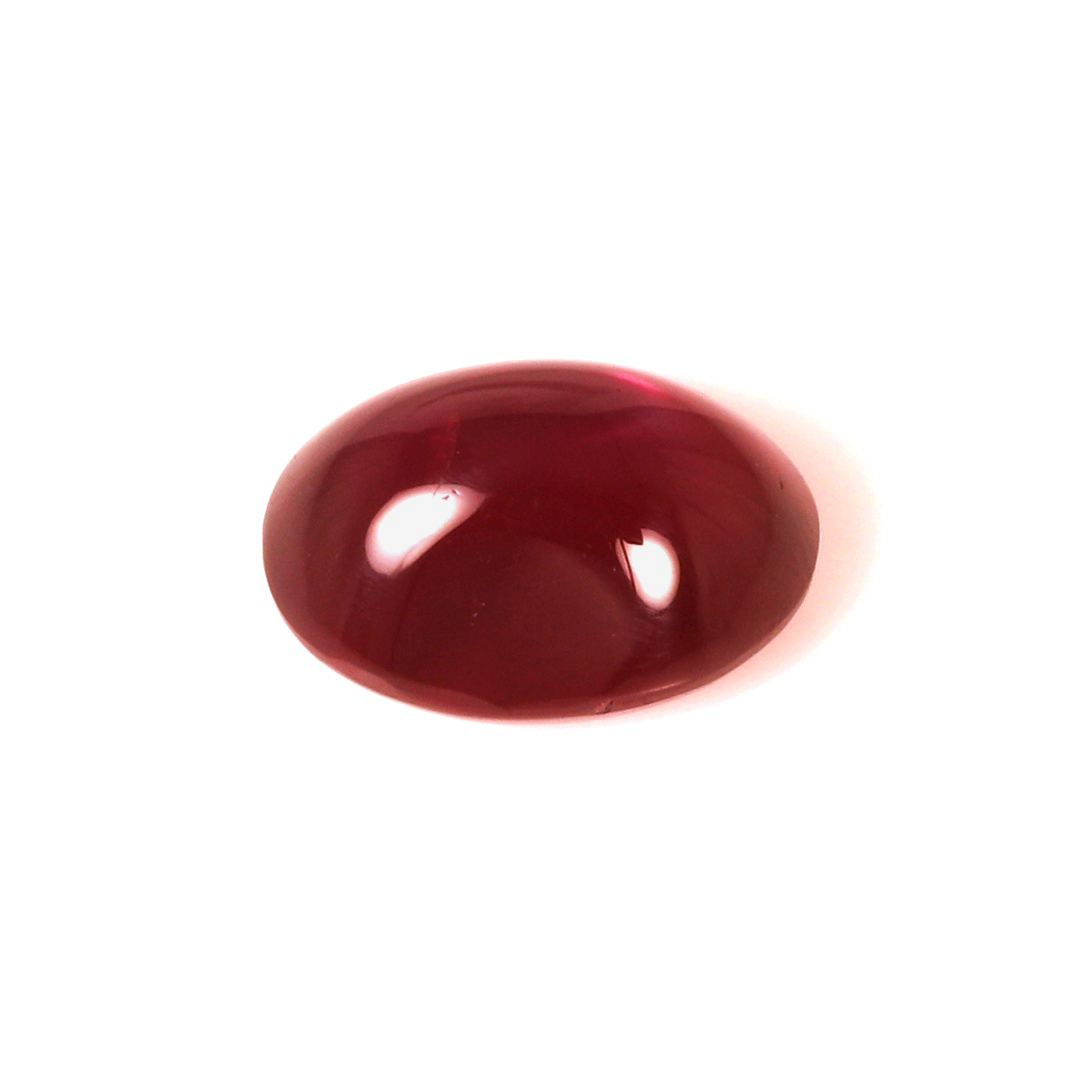
A single cabochon has a domed top and flat base. A double cabochon is domed on both sides, which lets more light through the stone and can make the color glow. Compare the two styles in the stones below.
How Much Does a Star Ruby Cost?
Natural star rubies on our site range from about $200 for small stones to about $62,000 for large, vivid stones when this post was last reviewed. Size, the sharpness of the star, the body color and treatment move the price most.
Star Rubies in Our Inventory
This section lists stones in our inventory when this post was last reviewed. Individual stones can sell; the guidance above stays the same.
The stones below are all natural oval cabochons, from three different origins. Five are listed with no enhancement and one as heat treated.
| Stone | Weight and cut | Color | Clarity | Origin | Enhancement | Size (mm) |
|---|---|---|---|---|---|---|
| 3.04 ct Burmese star ruby (R13707) | 3.04 ct oval double cabochon | Red, Vivid | Eye Clean | Burma (Myanmar) | None | 9.27 × 6.89 × 4.74 |
| 6.05 ct Burmese star ruby (R14538) | 6.05 ct oval double cabochon | Pinkish Red, Intense | Very Slightly Included | Burma (Myanmar) | None | 11.04 × 8.49 × 6.11 |
| 5.93 ct Mozambique star ruby (R16201) | 5.93 ct oval cabochon | Purplish Red, Intense | Very Slightly Included | Mozambique | None | 10.71 × 8.65 × 6.25 |
| 17.55 ct Burmese star ruby (S2828) | 17.55 ct oval cabochon | Purplish Red, Vivid | Very Slightly Included | Burma (Myanmar) | None | 16.74 × 13.30 × 6.74 |
| 12.65 ct Mozambique star ruby (R14080) | 12.65 ct oval cabochon | Purplish Red, Vivid | Very Slightly Included | Mozambique | Heat treated | 13.26 × 11.54 × 8.38 |
| 27.41 ct Vietnamese star ruby (S2452) | 27.41 ct oval cabochon | Red, Vivid | Very Slightly Included | Vietnam | None | 17.03 × 15.54 × 8.74 |
A few stand-outs. Our 3.04 ct Burmese star ruby (R13707) is listed Eye Clean, which is unusual in a star ruby, and has a vivid red body color. The 17.55 ct Burmese star ruby (S2828) has a vivid purplish red color and no enhancement. The largest is the 27.41 ct Vietnamese star ruby (S2452), with a vivid red color, also with no enhancement.
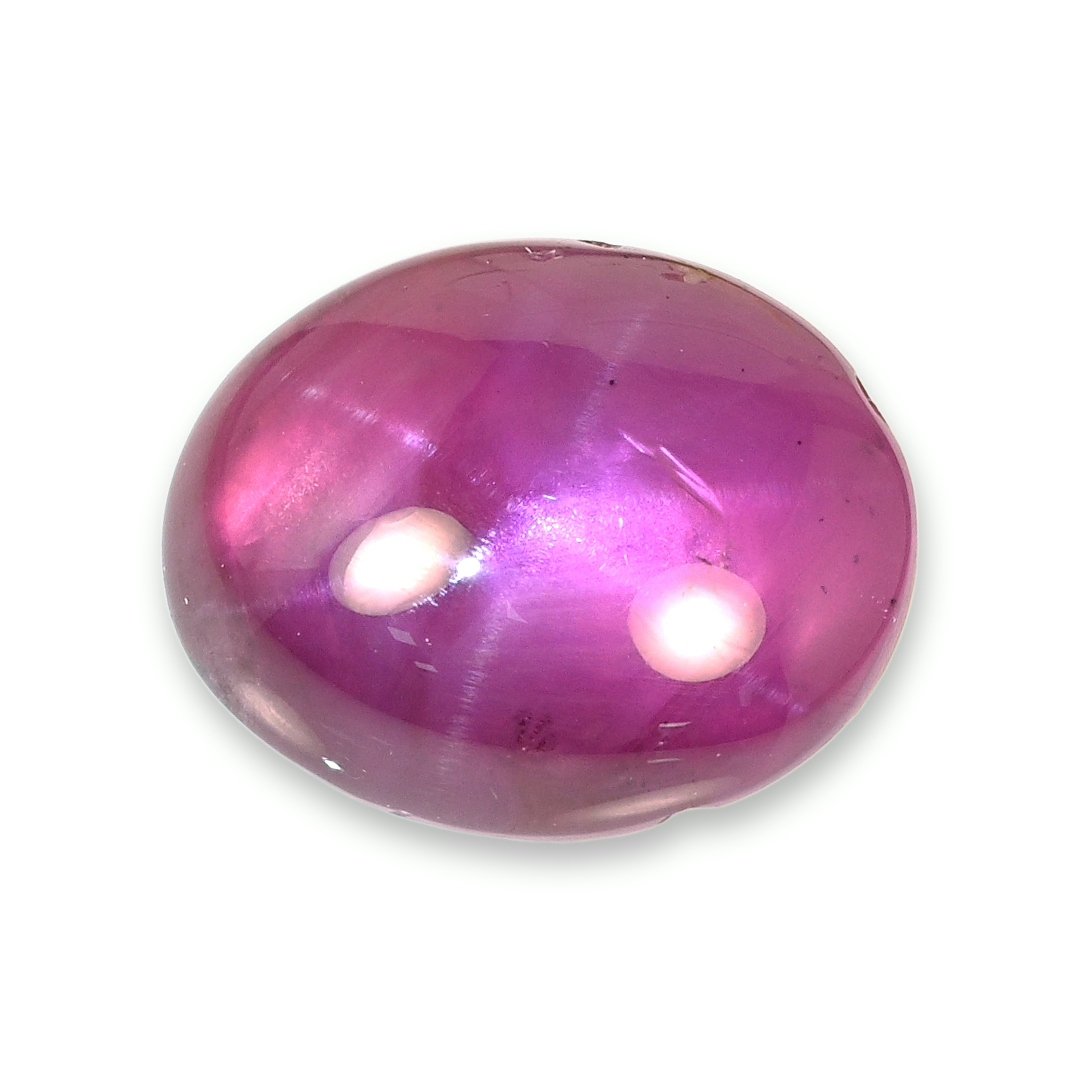


A star ruby needs motion. In these videos the star shifts across the dome as the stone is turned.
A Star Ruby as Jewelry
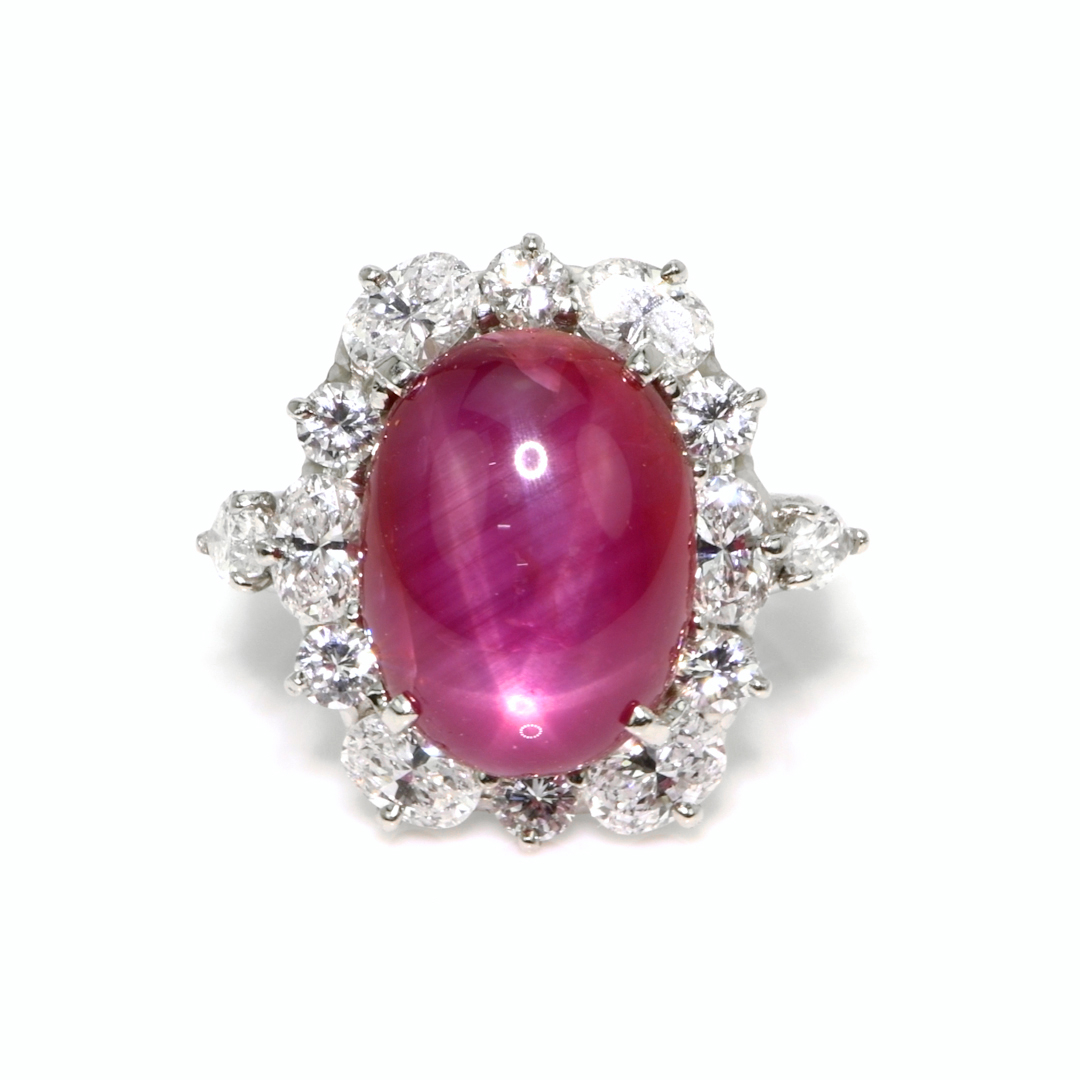
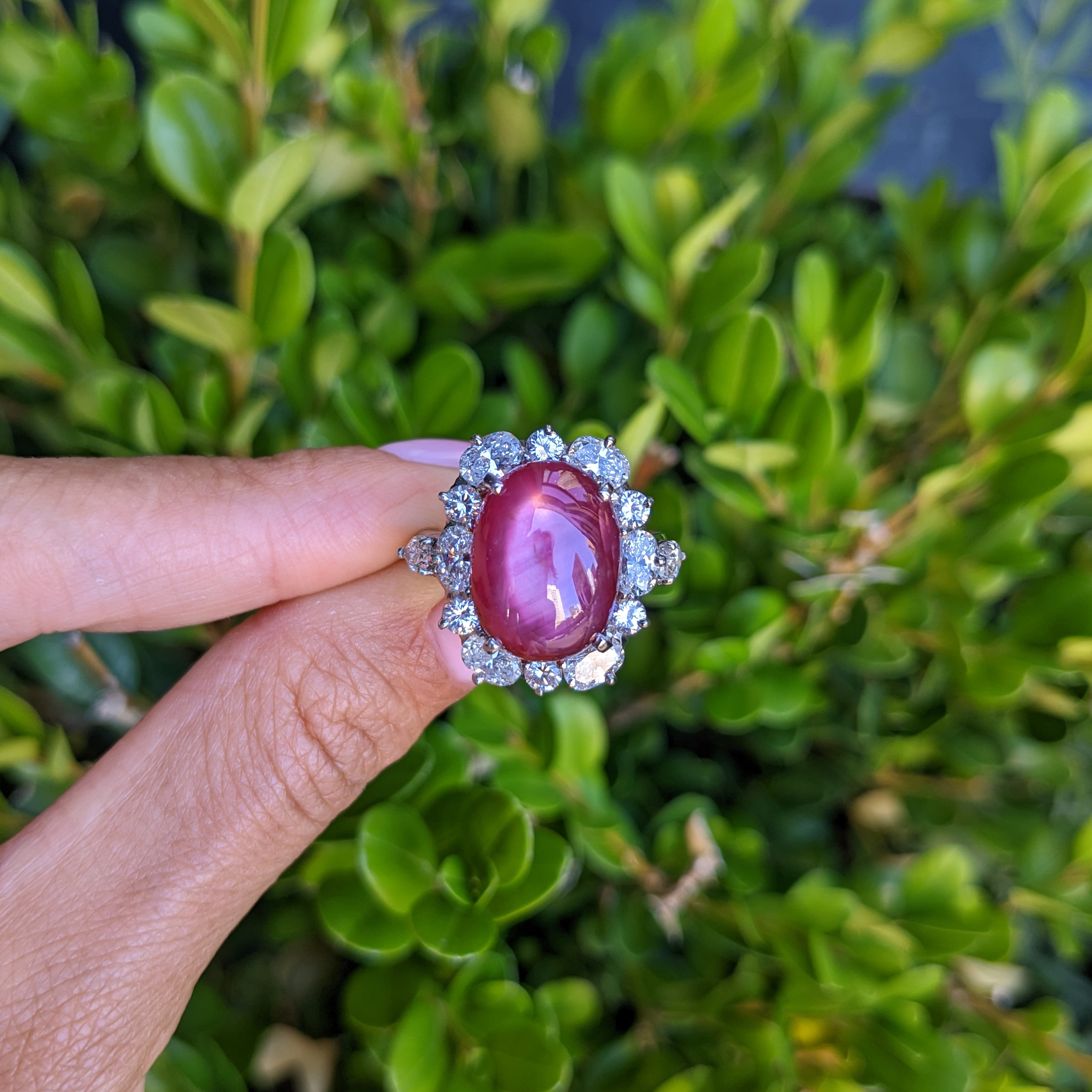
A star ruby makes a bold ring because the dome sits comfortably in a bezel or a low setting. Our 14.94 ct star ruby ring (J12435) is an oval double cabochon in platinum 950 with natural diamond pavé.
How Do I Care for a Star Ruby?
Ruby is a hard, durable gem (9 on the Mohs scale), so a star ruby suits everyday wear. Clean it with warm, soapy water and a soft brush, and keep it from hard knocks that could chip the girdle. A cabochon’s dome is less exposed than a faceted gem’s corners, which is one reason star rubies work so well in rings. Avoid re-polishing a star ruby without a gemologist’s advice, and keep it out of ultrasonic cleaners: GIA advises that star rubies should not be cleaned in an ultrasonic machine.
For why every ruby, star or faceted, looks a little different, see Why Are No Two Natural Rubies Exactly Alike?. For how labs describe the finest ruby red, read What Does “Pigeon’s Blood” Really Mean in a Ruby?. To compare more, browse our star rubies.
Frequently Asked Questions
What causes the star in a star ruby?
In a natural star ruby, tiny needles of rutile oriented in three directions reflect light into a six-rayed star, a phenomenon called asterism.
Are star rubies natural?
Some are, but many star rubies on the market are synthetic (Linde-type, grown in a laboratory since the late 1940s) or have a star created by diffusion treatment. A natural star ruby gets its star from rutile silk that grew in the crystal. Our star rubies are natural stones, and the enhancement status of each one is on its product page.
How can I tell if a star ruby is real?
Warning signs of a synthetic are a star that is too sharp and perfect, very even color, and, under magnification, curved growth lines and gas bubbles. A star that sits only at the surface may be diffusion-induced. A gem lab report is the reliable way to confirm a natural, untreated star ruby.
What is a Linde star ruby?
A synthetic star ruby made by the process Linde patented in the late 1940s. It is a real corundum, but it is laboratory-grown and worth a small fraction of a natural star ruby.
Why are star rubies cut as cabochons?
A dome lets the cutter align the needles under the surface so the rays cross at the top. Faceting would break up the effect.
What is the most famous star ruby?
The Rosser Reeves Star Ruby, a 138.7-carat stone from Sri Lanka at the Smithsonian’s National Museum of Natural History.
How much is a star ruby worth?
It depends on size, star quality, color and treatment. Natural star rubies on our site range from about $200 to about $62,000.
Are star rubies durable enough for a ring?
Yes. Ruby is 9 on the Mohs scale and the smooth dome is resistant to chipping, but avoid hard impacts.
Sources: GIA Gems & Gemology: Synthetic star sapphires and rubies (Fall 2017); GIA Gems & Gemology: Dual-color double stars (Summer 2015); GIA: Ruby; GIA 4Cs: Gems and ultrasonic cleaners; Smithsonian National Museum of Natural History (Rosser Reeves Star Ruby). Stone specifications are taken from the product pages linked above.