
The Rubies of the Mughal Empire
The Mughal Empire was famous for extraordinary wealth, magnificent architecture, and a royal treasury filled with some of the world’s most remarkable gemstones. The Rubies of the Mughal Empire were among these treasured possessions, admired for their rich red color, impressive size, and royal associations. Diamonds, emeralds, pearls, sapphires, and other brilliant red stones also decorated everything from royal jewelry to ceremonial objects and thrones.
Among these treasures, stones historically described as rubies held a particularly important place. Their intense red color represented wealth, status, and imperial authority, while exceptionally large examples were preserved and passed between generations of rulers.
Yet the history of The Rubies of the Mughal Empire contains an intriguing complication. Some of the most celebrated red gemstones associated with the Mughal court were not actually rubies at all. They were red spinels, which were historically grouped with rubies because the two gemstones could be extremely difficult to distinguish before modern gemology.
Their stories reveal a world in which gemstones were more than decoration. They were symbols of power, war, succession, and royalty.
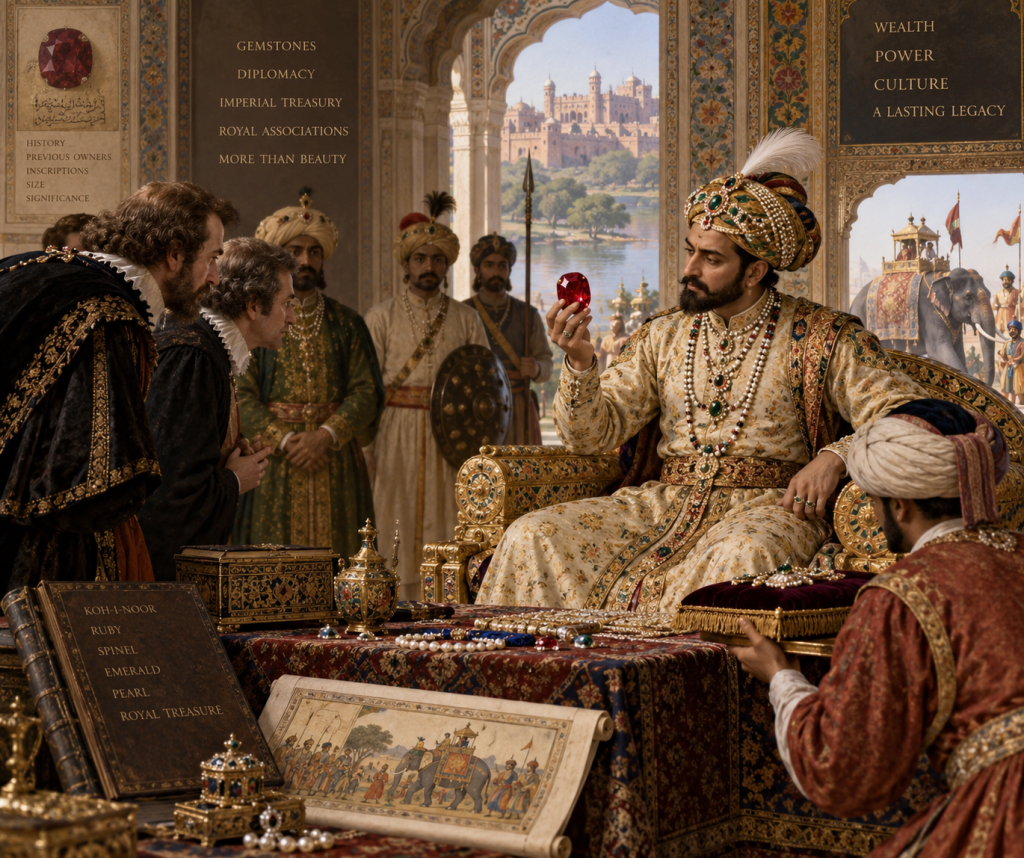
Why the Mughals Valued Red Gemstones
The Mughal emperors ruled much of the Indian subcontinent from the early 16th century, establishing one of the wealthiest and most culturally influential empires of the period.
Gemstones occupied an important position within Mughal court culture. Exceptional stones could be worn by emperors, presented as diplomatic gifts, incorporated into ceremonial objects, or preserved within the imperial treasury.
Large red gemstones were particularly impressive because of their rarity and striking appearance.
They were not simply judged according to the modern 4Cs. Their histories, previous owners, inscriptions, size, and royal associations could be equally significant.
Owning an extraordinary gemstone was a visible demonstration of imperial wealth.
Emperor Jahangir and His Passion for Gemstones
Jahangir, who ruled the Mughal Empire from 1605 to 1627, had a well-documented interest in art, nature, and precious stones.
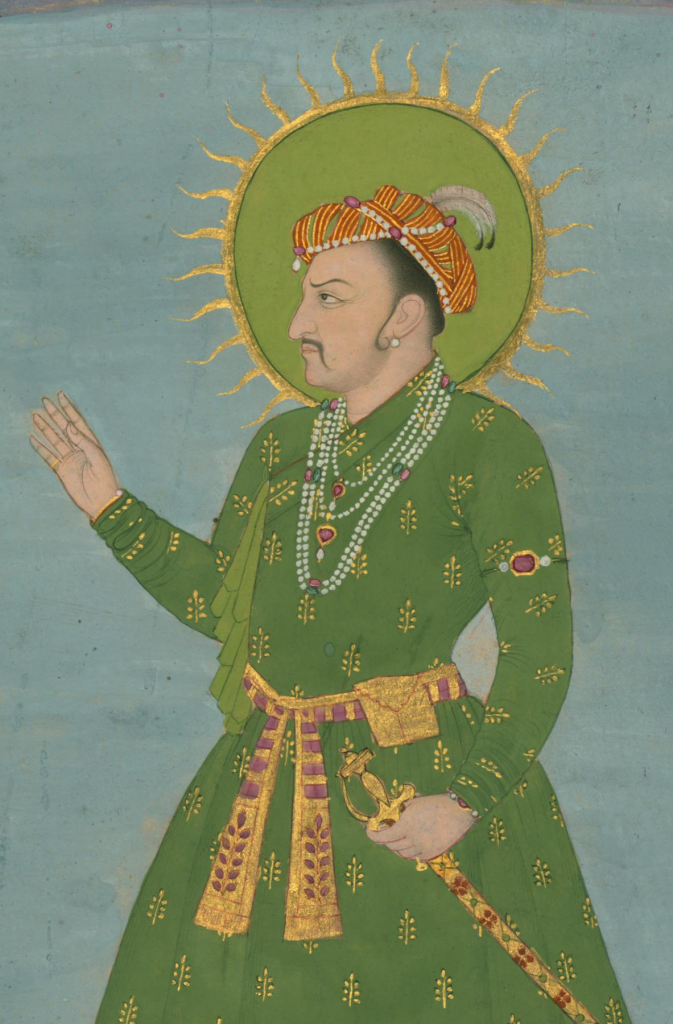
During the Mughal period, important gemstones were sometimes engraved with the names and titles of rulers. Jahangir’s name appears on several historic stones associated with the imperial treasury.
These inscriptions had significance beyond simple ownership.
By placing an imperial name on a gemstone, the ruler transformed an already valuable natural object into a symbol of dynasty and authority. The gemstone could then carry that association long after the ruler’s death.
Today, these inscriptions are especially valuable to historians because they can provide clues about a gemstone’s journey through different royal collections.
Shah Jahan and an Age of Extraordinary Luxury
Jahangir’s son, Shah Jahan, ruled from 1628 to 1658 and became one of the most famous Mughal emperors.
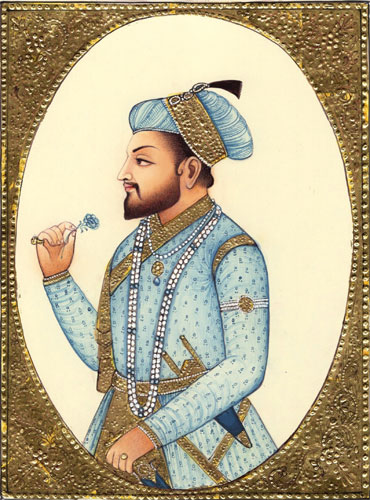
He is best remembered for commissioning the Taj Mahal, but his court was also renowned for exceptional luxury and craftsmanship.
Gemstones were incorporated into jewelry, weapons, ceremonial objects, clothing, and architectural decoration. The imperial treasury contained extraordinary diamonds, emeralds, pearls, and red gemstones collected over generations.
Perhaps no object better represented Mughal wealth than Shah Jahan’s legendary Peacock Throne.
The Peacock Throne and the Mughal Treasury
The Peacock Throne became one of the most famous symbols of Mughal imperial power.
Created for Shah Jahan, it was reportedly covered with gold and decorated with an extraordinary collection of precious gemstones. Historical descriptions portray it as a spectacular display of royal wealth.
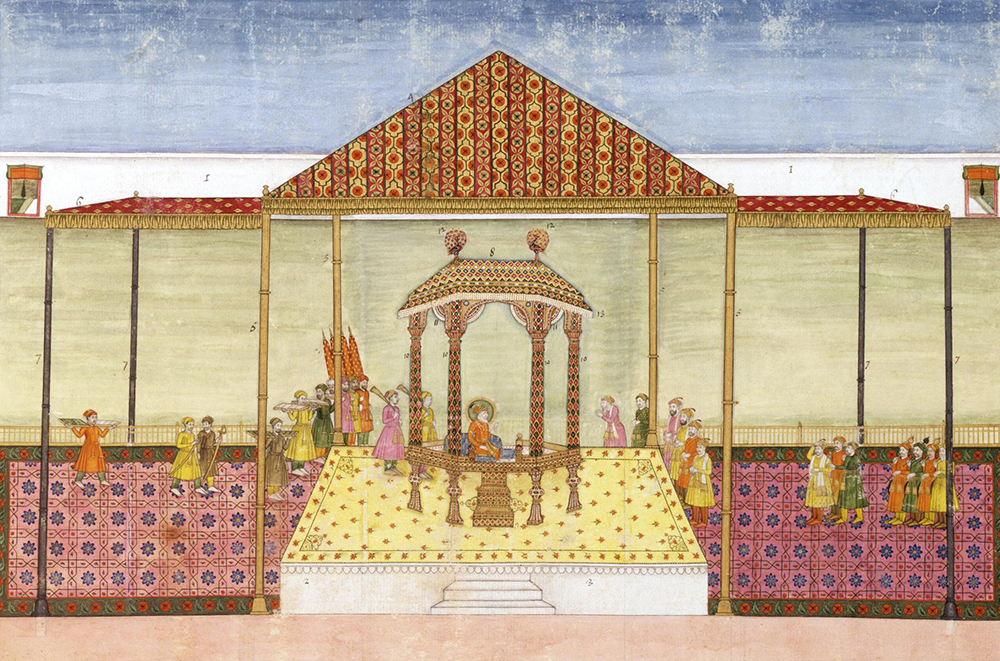
Rubies and other red gemstones formed part of the broader jeweled world surrounding the Mughal court.
The throne was more than an expensive object. It communicated a political message: the emperor sat at the center of an immensely wealthy and powerful empire.
But the Mughal treasury would eventually become the target of another ambitious ruler.
War Changed the Ownership of the Gems
In 1739, Persian ruler Nader Shah invaded northern India and captured Delhi.
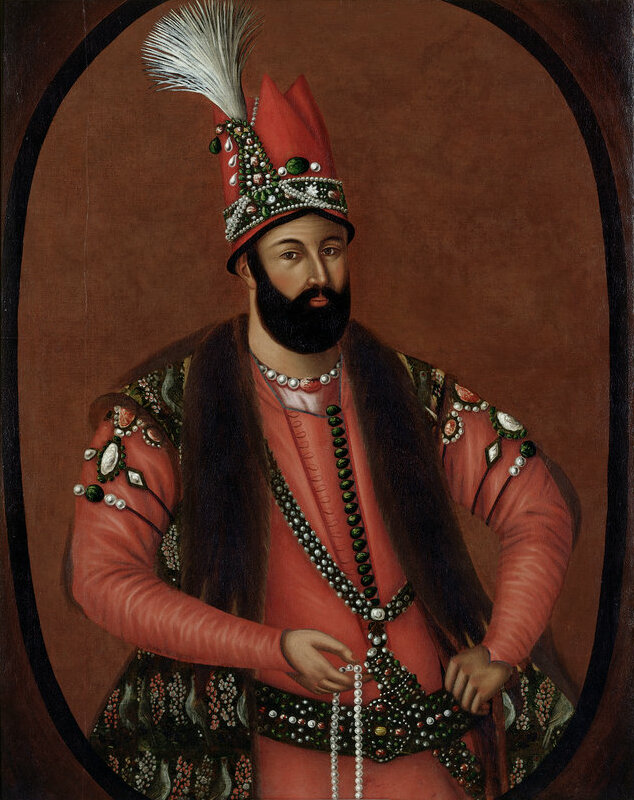
The invasion became a devastating event in Mughal history. Enormous quantities of wealth were removed from the imperial treasury and carried back to Persia.
Among the treasures traditionally associated with Nader Shah’s conquest were the Peacock Throne and numerous famous gemstones.
The event illustrates one of the most dramatic aspects of historic gemstone ownership. Royal gems did not always pass peacefully from one generation to another.
They could change hands through war, conquest, political collapse, inheritance, and diplomacy.
A gemstone that symbolized one ruler’s power could eventually become a trophy representing another ruler’s victory.
The Timur Ruby and the Mughal Emperors
One of the most fascinating red gemstones connected with Mughal history is the Timur Ruby.
The enormous stone weighs approximately 352.5 carats and carries inscriptions associated with several rulers, including Mughal emperors Jahangir, Shah Jahan, Farrukhsiyar, and Ahmad Shah.
Its traditional name connects it with Timur, or Tamerlane, although the exact early history of the stone remains uncertain.
For centuries, it was described as a magnificent ruby.
Modern gemological understanding, however, identifies it as a red spinel.
Its mistaken identity offers an important clue to understanding many historic “rubies.”
For more details about this fascinating gemstone and its royal history, visit our article on The Timur Ruby HERE.
Were the Mughal Rubies Really Rubies?
Not always.
Before modern gemology developed, ruby and red spinel were frequently confused because both could display beautiful, saturated red coloration.
A true ruby is the red variety of corundum, while spinel is an entirely different mineral.
Today, gemologists can distinguish them through their physical, optical, and chemical characteristics. Mughal rulers did not have access to these scientific techniques.
This means that historical documents describing “rubies” cannot always be interpreted according to today’s gemological definition.
Some famous royal rubies were eventually revealed to be spinels.
That does not mean the Mughal emperors considered these stones unimportant. Quite the opposite: exceptional red spinels were among the great treasures of Asian royal courts.
Why Were Spinels So Highly Prized?
Fine red spinels can possess exceptional transparency, brilliance, and rich coloration.
Historically, some important spinels came from Central and South Asian sources and reached royal courts through extensive trade networks. Large, attractive specimens were rare enough to become imperial treasures.
Their smooth surfaces also provided an opportunity for rulers to add inscriptions.
Some surviving historic spinels therefore carry the names of multiple emperors, transforming them into miniature records of political history.
Today, those inscriptions can make the gemstones even more fascinating than perfectly cut modern stones.
Gemstones as Symbols of Political Power
To understand Mughal gemstones, it is important to look beyond jewelry.
An enormous ruby, spinel, emerald, or diamond could represent control over resources, successful trade relationships, military victories, or inherited imperial wealth.
Gemstones were portable forms of extraordinary value. Unlike palaces or monuments, they could travel with rulers, be presented as gifts, transferred to heirs, or taken after military defeat.
This portability explains why the histories of famous gemstones often cross national and dynastic boundaries.
The same stone might appear in a Mughal treasury, a Persian royal collection, a Sikh ruler’s possession, and eventually a European royal collection.
From Mughal Treasures to European Collections
The decline of Mughal political power resulted in many imperial treasures being dispersed.
Some passed into Persian collections following Nader Shah’s invasion. Others later became associated with regional rulers, including the Sikh Empire.
During the expansion of British power in India, a number of historically significant gemstones eventually reached Britain.
The Timur Ruby, for example, entered British possession and was presented to Queen Victoria in 1851. It remains part of the British Royal Collection.
The journey of such gemstones reflects centuries of changing political power.
What Modern Gemology Changed
Modern gemology has transformed our understanding of historic royal gemstones.
Scientific examination can now distinguish ruby from spinel and identify many other gemstones that might once have been grouped together based primarily on color.
Ruby is a variety of corundum and ranks 9 on the Mohs hardness scale. Spinel is a separate mineral and ranks around 8, although both can be highly durable and exceptionally beautiful.
This scientific distinction explains why some famous historic “rubies” have been reclassified.
Their historical names often remain, however, because those names have become part of their identities.
More Than Beautiful Stones
The red gemstones of the Mughal Empire demonstrate why historic jewelry can tell us so much about the past.
A gemstone can reveal changing ideas about science and identification. An inscription can document royal ownership. Its movement from one treasury to another can reflect war, conquest, and the rise and fall of empires.
For collectors and gemstone enthusiasts today, these stones are fascinating precisely because their importance extends beyond carat weight or market value.
They are pieces of history.
Final Thoughts
The Rubies of the Mughal Empire belonged to a world where gemstones represented far more than personal luxury. They were symbols of imperial authority, diplomatic gifts, inherited treasures, and sometimes prizes of war.
Their stories connect rulers such as Jahangir and Shah Jahan with the magnificent Mughal treasury, the Peacock Throne, Nader Shah’s invasion of Delhi, and the later movement of royal treasures across Asia and Europe.
Modern gemology has added another fascinating layer to that history by revealing that some legendary Mughal “rubies” were actually red spinels.
Yet their reclassification has done little to diminish their importance.
Whether ruby or spinel, these extraordinary red gemstones remain witnesses to centuries of ambition, artistry, conflict, and royal power and reminders that sometimes the history carried by a gemstone can be even more valuable than its name.
Explore our best collection of natural rubies and discover exceptional gemstones selected for their beauty and quality.