
- Ring7
- Reports2
-oval-ruby-ring-4.5700-cts-j11965-1.jpg?d=200x200&v=20260406134547)
-oval-ruby-ring-4.5700-cts-j11965-2.jpg?d=200x200&v=20260406134547)
-oval-ruby-ring-4.5700-cts-j11965-3.jpg?d=200x200&v=20260406134547)
-oval-ruby-ring-4.5700-cts-j11965-4.jpg?d=200x200&v=20260406134547)


-oval-ruby-ring-4.5700-cts-j11965-1.jpg?d=750x750&s=nrc&v=20260406134547)
-oval-ruby-ring-4.5700-cts-j11965-2.jpg?d=750x750&s=nrc&v=20260406134547)
-oval-ruby-ring-4.5700-cts-j11965-3.jpg?d=750x750&s=nrc&v=20260406134547)
-oval-ruby-ring-4.5700-cts-j11965-4.jpg?d=750x750&s=nrc&v=20260406134547)
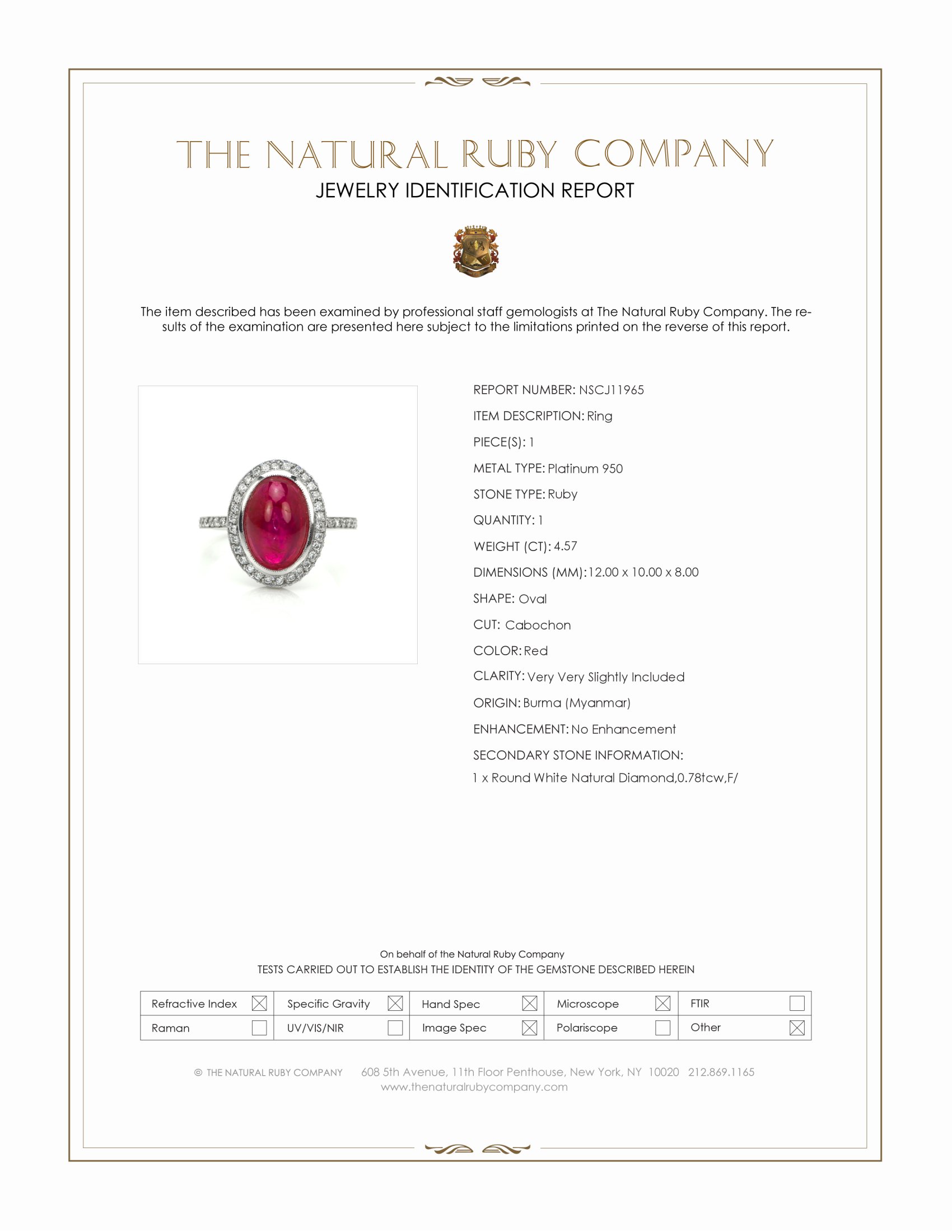

4.57 Ct. Ruby and Natural Diamond Pave Ring, Platinum 950
This ring is available to ship now
Stone type: | Ruby | Natural Diamond |
|---|---|---|
Quantity: | 1 | 0 |
Dimensions (MM): help | Length: 12 Width: 10 Height: 8 | Length: 1 Width: 1 Height: 1 |
Total weight: | 4.57 Ct. | 0.78 Ct. |
Color: | Red | White |
Color intensity: help | Vivid | N/A |
Color grade | N/A | F |
Clarity: | Very Very Slightly Included | VS1 - Very Slightly Included |
Shape: help | Oval | Round |
Cut: | Cabochon | Brilliant |
Cutting style: | Cabochon | Faceted |
Enhancements: help | No Enhancement | No Enhancement |
Origin: help | Burma (Myanmar) | Unknown |
This ring is executed in platinum nine hundred fifty, a choice that prioritizes structural integrity and long term wearability. The mounting is engineered as a low profile bezel around the central cabochon, the bezel transitioning into a double halo of hand set melee diamonds that continue down the shoulders in pavé. The central stone is an oval cabochon of ruby cut with a high dome and a smooth table, the cabochon style chosen to emphasize depth of color and internal texture over faceted brilliance. The gallery is opened and contoured to allow light to enter the culet area and to provide ventilation for the setting, while the bezel and halo are chamfered and burnished by hand to ensure secure seating and resistance to impact. All diamonds are matched for size and tone, and are set using micro setting techniques that minimize metal visibility, the result being a precise optical frame that enhances the ruby without competing with it.
From a gemologic perspective the central ruby exhibits a deep, saturated red body color with a slightly purplish overtone visible at different angles, and a translucency that allows three dimensional color play rather than surface reflection alone. The cabochon cut reduces the expression of pleochroism seen in faceted rubies, instead rendering a homogenous color field that varies with the dome curvature and ambient light. Internally the stone reveals fine silk like rutile inclusions and irregular liquid fingerprints consistent with natural corundum growth, inclusions that scatter light and contribute to the perceptual richness and velvety depth of the red. The hardness of corundum provides outstanding wear resistance, the cabochon profile further protecting the edges from chipping. Color origin in rubies is chromium trace elements substituting in the corundum lattice, and the interaction between chromium concentration and iron content governs tone and saturation, factors that are evident in the warm yet intense hue of this cabochon.
When compared to lab grown alternatives, there are clear technical distinctions that informed buyers will appreciate. Lab grown rubies produced by flame fusion tend to exhibit curved growth lines and gas bubbles, while flux grown and hydrothermal synthetics show metallic flux inclusions or growth features that differ in morphology from natural corundum silk and fingerprint inclusions. Lab grown stones can achieve very high clarity and extreme uniformity of color, because conditions in the growth environment can be controlled to minimize inclusions and zoning. This results in a different visual character for cabochons, often a flatter, more homogeneous color field that lacks the micro contrast created by natural silk networks. From a stability and care standpoint both natural and lab grown corundum share the same hardness and chemical stability, however treated natural stones that have undergone glass filling or resin filling require additional consideration for heat and solvent exposure, and their filled features can be detectable under magnification, affecting long term durability and value. Lab grown stones rarely require such filling to reach saturated color in small to medium sizes, but they also lack the provenance and scarcity premium associated with well colored natural rubies, a factor that collectors and connoisseurs weigh heavily.
For the buyer who values artisanal execution and natural gem character, this piece offers a compelling combination of technical design and gemstone personality. The use of platinum nine hundred fifty ensures that the bezel and halo retain their structural fidelity with minimal maintenance, and the hand labor involved in micro pavé and bezel burnishing produces tight tolerances that protect the cabochon profile. Conservation minded care is simple, clean with mild detergent and a soft brush, avoid steam and harsh acids if the stone has unknown filling treatment, and periodic inspection will ensure the bezel remains secure. In contrast a lab grown equivalent will offer price efficiency and near flawless visual uniformity, an advantage if the objective is pure color without natural inclusion texture. For collectors and buyers seeking intrinsic gemological interest, the natural silk and growth morphology present in this cabochon create visual complexity and depth that laboratory growth cannot replicate, and that complexity is what elevates the piece beyond a simple color stone into an object that rewards close inspection and long term appreciation.


Other Rings You May Like
